
Millions of American adults are missing one or more teeth because of decay, gum disease and oral injury. After tooth extraction or loss, jaw bone and gums recede rapidly, and adjacent teeth weaken as they drift toward the empty tooth socket. For individuals missing all of their teeth, the toll on their self-image, nutrition and speech is devastating. So, Dr. David Tripulas, often advises placement of dental implants in Wharton. Secured in the jaw bone, dental implants provide amazingly natural-looking and stable tooth replacement.
What is a Dental Implant?
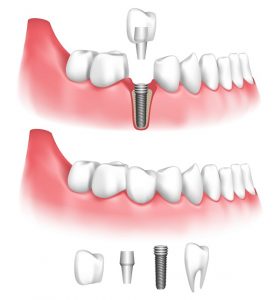
The visible portion of a single dental implant looks like a real tooth because what shows above the gumline is a realistic porcelain crown, color-matched and shaped to blend in with the rest of the patient’s smile. Beneath the gums, the dental implant itself is a titanium screw which an oral surgeon inserts directly into the jaw bone. A metal alloy extension post joins the implant screw and the porcelain crown together.
In addition, dental implants may be placed in multiples so they fully anchor lifelike prosthetics made of tooth and gum colored acrylic: either bridgework or full or partial dentures. Whatever the situation, the patient needs a sufficiently healthy and dense jaw bone to receive the implant devices.
Getting Dental Implants
First, Dr. Tripulas performs a comprehensive oral examination and takes digital X-rays and other imaging to determine if a patient can have a dental implant. With that determined, he refers the patient to a trusted area oral surgeon for placement of the implant device.
The surgeon begins the procedure by numbing the area and incising the gums. He or she drills a small hole into the bone and places the implant screw. The surgeon closes the site, and the patient returns home for a period of healing.
Depending on the kind of implant device placed, healing, or osseointegration as scientists call it, takes several weeks. During this time, the jaw bone actually bonds with the titanium implant device, practically guaranteeing its success and long-term retention. After healing is complete, the patient returns to Dr. Tripulas who finishes the tooth replacement with a post and crown. As time goes by, the jaw bone continually is exercised and strengthened as the patient bites and chews on the dental implant.
Modern Dental Technology
It’s truly a wonder. Dental implant patients in Wharton can anticipate enjoying their prosthetics literally for decades. Success rates for dental implants are around 98 percent, and as such, implants are likely the last tooth replacements the individual will need. Individuals just brush twice a day and floss daily to avoid the build-up of plaque and tartar which undermines gums and bone. They also need to see Dr. Tripulas twice a year for cleanings and examinations.
Implant patients enjoy Dr. Tripulas’ chairside manner and exceptional skill set. He has attained Master level with the Academy of General Dentistry, and he really loves placing dental implants and seeing how a patient’s oral function and smile aesthetics improve.
Learn More about Dental Implants
Contact Dr. David Tripulas and his team to arrange a restorative dentistry consultation. Your dentist will explain your tooth replacement options and the entire treatment process. Look forward to a strong and beautiful smile!